Waiting for Girl-World: Absurdism, Maximalism, and Femininity in Exil i Hello Kitty City
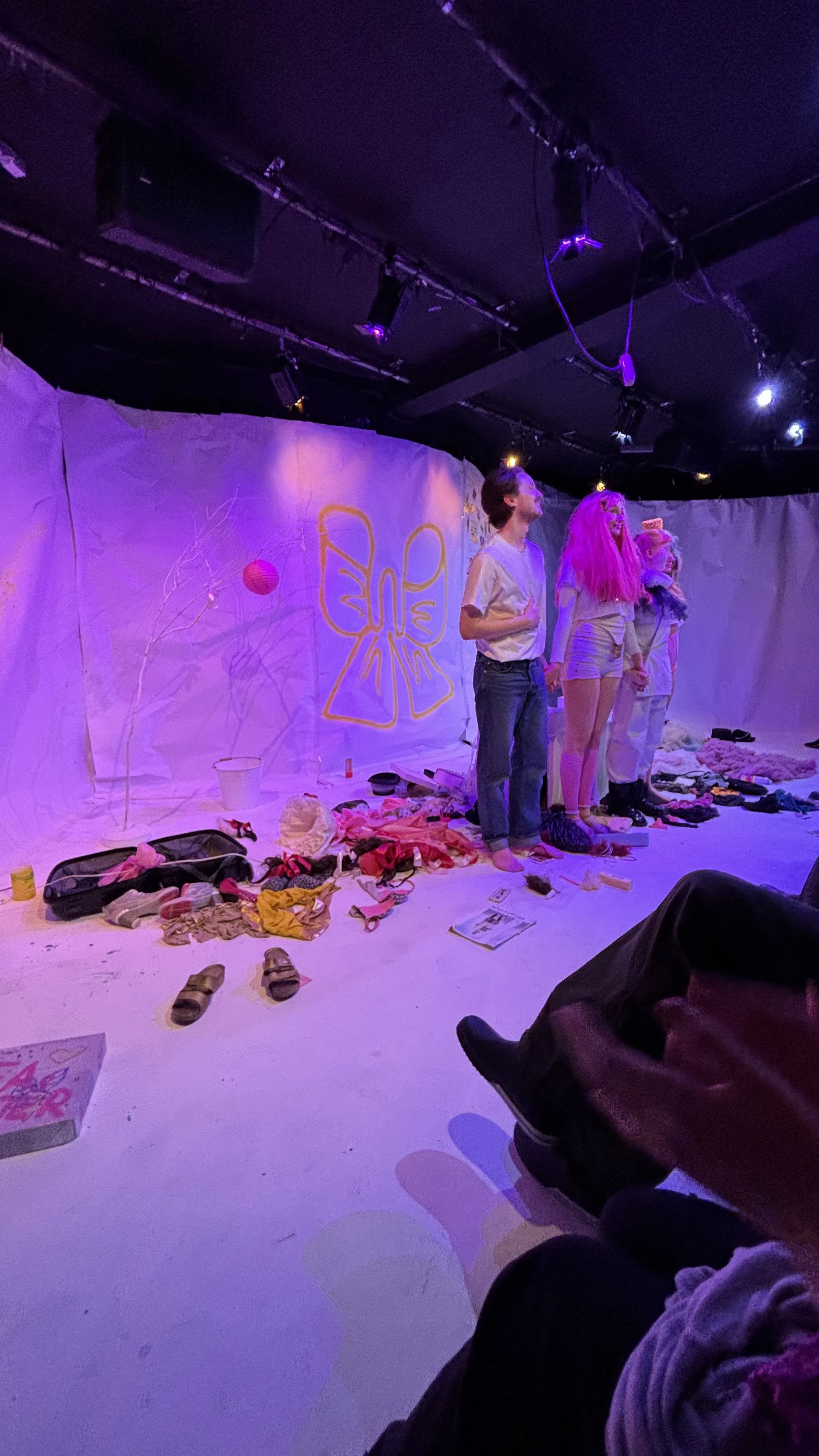
In Fanny Lindstedt Grahn’s Exil i Hello Kitty City (performed January 2026 at Teater Brunnsgatan Fyra, Stockholm), two women sit and wait on a sparsely appointed stage. The theatrical space is demarcated by several sheets of white paper, which hang suspended from the rafters, cleaving the space to create one side entrance, stage left. The play, which takes its departure from Samuel Beckett’s Waiting for Godot, lands on gendered ground immediately. Beckett’s estate, notoriously litigious in their protections of copyright and the writer’s artistic intentions, has blocked any production of Godot with non-male actors since its publication in 1954 (Hartley 2020, 132). Beckett, during his lifetime, was known to have said that the play was not to be performed by anyone without a prostate (Wyver 2020), and wrote in a letter in 1973, “I AM AGAINST WOMEN PLAYING GODOT. … Theater sex is not interchangeable” (Hartley 135). As a response to such strictures, Lindstedt Grahn’s work is not a direct translation of Beckett’s, but rather takes certain fundamentals and uses them as a point of departure.
As is indicated by its title, the fundamental conceit of Waiting for Godot is just that — waiting. Two men, Vladimir and Estragon, sit and wait for the named but unknown Godot, and in the idiosyncratic and often absurd conversation that substantiates this waiting, they move, through non-sequitur and non-sense, to some sense of equilibrium (Beckett 1954). Like Godot, Hello Kitty City operates from a similar posture: two characters, Beatrice and Masja, are waiting for an unknown character. Except in this case, rather than Godot (which they self-consciously refrain from saying, sometimes catching themselves hanging on the voiced first consonant, “Go—”), the two women wait for Daniel; Daniel, who might be at band practice, who might love them more if they would dress and look like he does, whose eyes they don’t know the color of but dream of anyway (Lindstedt Grahn 2025, 15-40). “It will feel better when he comes,” pronounces Beatrice (Lindstedt Grahn, 19).
On its surface, or perhaps if staged or costumed differently, Hello Kitty City could seem to operate within and reinforce a rigid binary, its oppositional stance to Beckett’s own edicts just as stringent, just as focused on the very biology of its players. But, thanks to an absurd maximalism that stretches well beyond the script, Hello Kitty City instead lands in a zone of playful abandon, much closer to Jill Dolan’s “utopian performative” ideal. The theater, or at very least the zone of theatricality, Dolan writes, allows for “small but profound moments in which performance calls the attention of the audience in a way that lifts everyone slightly above the present, into a hopeful feeling of what the world might be like if every moment of our lives were as emotionally voluminous, generous, aesthetically striking, and intersubjectively intense [as the performed moment is]” (Dolan 2016, 240). In the case of Hello Kitty City, these moments are achieved through the very absurdism and existentialism Beckett seemed to cordon off as a male-only enterprise in Godot.
Take, for example, the costuming: Beatrice and Masja both wear a bra and panties. But Masja wears not just one bra but many, stacked around her torso and down over her hips, spun in all sorts of orientations, creating bulges and phantom breasts where there are none. And Beatrice, often rifling through some handbag or suitcase or box, constantly puts on and takes off pieces of clothing, at one moment crossing the stage topless, breasts unselfconsciously bared, and in the next moment piling on several large, brightly-colored tulle skirts, obfuscating her body while building up her physical presence on stage. As she layers these skirts, one atop the other, Beatrice says:
Something’s missing/ Maybe a scarf/ Or a bolero/ My mom always used to say/ Why don’t you take a little sweater/ Or a scarf over your shoulders/ So you don’t freeze/ But she actually meant/ So you don’t look like a whore/ She also always wanted me/ To buy clothes one size bigger/ Than what I wanted/ I don’t know if she was implying that I was fatter than I thought/ Or maybe that I might eventually get fatter/ Beatrice tries to put something on that’s obviously too small/ But I know my body best/ And I know what I should wear and what I shouldn’t. (Lindstedt Grahn 44-45)
As Beatrice steps into a pair of hot-pink, studded platform stilettos, or rings her mouth with fuchsia lipstick, heedless of where her lips begin and end, the audience is privy to a kind of femininity that is at odds with, yet still remains aware of, some external normative gaze. Beatrice (in a call-back to Beckett’s prostate-preoccupation) sits on a metal bucket and pees, walks around in her wig cap, which is secured with an overgrowth of black bobby pins, all crowded in one next to the other, and in general performs a vision of femininity that seems like it has unhinged itself from the bounds of propriety and been left, unbidden, to flirt around the edges of what is intelligible. In many ways, the treatment or proposal of gender and gendered acts is rendered on the teetering edge of imitation, an embodiment of Judith Butler’s definition of gender as a “stylized repetition of acts… which are internally discontinuous” (Butler 1999, 179).
This repeated dressing and undressing goes well beyond expressions of gender, however, and extends itself into the realm of class, place, and purchasing power. The sheer volume of props, and the ways in which Beatrice and Masja engage with those props, serves to orient our understanding of the play’s context. After all, absurdism must take its departure from, and ultimately bear the imprint of, the dominant socio-economic reality of the day. In Hello Kitty City, props are flung, shaken, tossed, and left to lie on the floor with relatively little interest for their future surety, coalescing into a singular meta-object: stuff. It is possible to interrogate and analyze the specific purse, or the specific lipgloss, the specific tampon, the specific hair extension which are all flung or shaken out of that purse’s interior. But taken together as a unit, we come to understand both the accessibility and disposability of these things. As an audience, we’re not really meant to lean in closely enough to examine the intricacies of these objects, nor are the characters onstage concerned with doing so. The closest they ever examine an object is when reading (“I’m reading Bukowski,” Masja says, though we’re free to doubt how much she actually takes in), or when Beatrice begins to cut up a women’s magazine, pasting images to the center stage curtain (Lindstedt Grahn 6-7). Otherwise, objects and their relative physical weightiness flit by just as quickly as topics of conversation do, creating a roiling flotsam that brings to mind trash floats in the Pacific and monstrous towers of fast-fashion clothing, gargantuan bushels of H&M graphic tees designed in Stockholm, sold to women of this city, and eventually filtered down to the open warehouses of rag sellers in Africa and South-East Asia. In short, the abandon with which this stuff flies in and out of our scope of attention is a singular indicator of Hello Kitty City’s origins — first world purchasing power, pink plastic everywhere. No thing is precious here; there’s always more where that came from.
The ease of disposability echoes in the way Beatrice and Masja speak to each other, allowing the audience to approximate the age of these two characters. The actresses appear youthful but not childlike, and their concerns and ways of speaking of them reflect a kind of suspension of responsibility. Though the actual pace of speech in Hello Kitty City is not notably fast, the overall movement of the play seems to be carried along on some internal rapids, and the lack of preciousness around the objects on stage is mirrored in the relative lightness with which Beatrice and Masja speak about themselves and their futures. They toss out ideas with a sort of youthful abandon, then move on from them before the ideas have time to settle, or to take effect in any meaningful way. Beatrice, determinedly rooting through her purse for something, becomes increasingly persistent in her search. “This is becoming worrying,” she says, and goes quiet for a moment. Then, “if I were to go and get pregnant/ maybe that would/ She gestures next to her head/ solve something” (Lindstedt Grahn 12). It’s an idea offered up in passing, which Masja hardly registers, just something said and left to drift on by with no real consequence. This stance, the overall speculative nature of the thought and its proposition, indicates a sort of suspension of disbelief. It’s as if the characters are implying that childbearing is something that women do, women “over there,” the general no-man’s land of adulthood, and not in this space, where they really are. In the child-like suspension of the mid-20s in Northern Europe, having a baby is offered up as a path to self-actualization, a way to seek and find purpose, and not, as it might be for women of the same age in other cultures or places, as a compulsion or expectation. Later, Beatrice returns to the subject: “Maybe I should just go get pregnant after all.” “It’ll happen/ sooner or later,” Masja says. “Nothing to do about it,” Beatrice replies (Lindstedt Grahn 75). Like children, they know that there’s something on the horizon — growing up, raising children. But for now, insulated from those eventualities, they sit and wait for Daniel.
Though Exil i Hello Kitty City takes its origins from Waiting for Godot and Beckett’s own edicts about gender, Hello Kitty City’s absurdism and existentialism leaps and lands in an entirely different world. Rather than the bleakness of inertia and the vastness of uncertainty of Beckett’s stage, in this world we approach a different kind of ledge: the swirling promise (and companionate disappointment) of the accessibility of everything, the peak of first-world girlhood and consumer culture. Here, we encounter the absurdity of maximalism rather than the drudgery of nihilism, an appropriate vision reflective of the abundance and pace of the 21st century. In Hello Kitty City, the play and the place, everything — even grief — is pink, playful, and possible.
Works Cited
Beckett, Samuel. Waiting for Godot. New York: Grove Press, 1954.
Butler, Judith. Gender Trouble: Feminism and the Subversion of Identity. 10th ed. London: Routledge, 1999.
Dolan, Jill. “Utopian Performatives.” In The Performance Studies Reader, edited by Henry Bial and Sara Brady, 240–250. London: Routledge, 2016.
Hartley, Alexander. “Beckett’s Legal Scuffles and the Interpretation of the Plays.” Journal of Modern Literature 43, no. 3 (Spring 2020): 132–149. Bloomington: Indiana University Press.
Lindstedt Grahn, Fanny. Exil i Hello Kitty City. Unpublished manuscript, 2025.
Wyver, Kate. “Not Waiting for Godot: New Show Tackles Beckett’s Ban on Women.” The Guardian, October 18, 2020.
https://www.theguardian.com/stage/2020/oct/18/not-waiting-for-godot-new-show-tackles-becketts-ban-on-women.