An Essay on My Latest Instagram Post
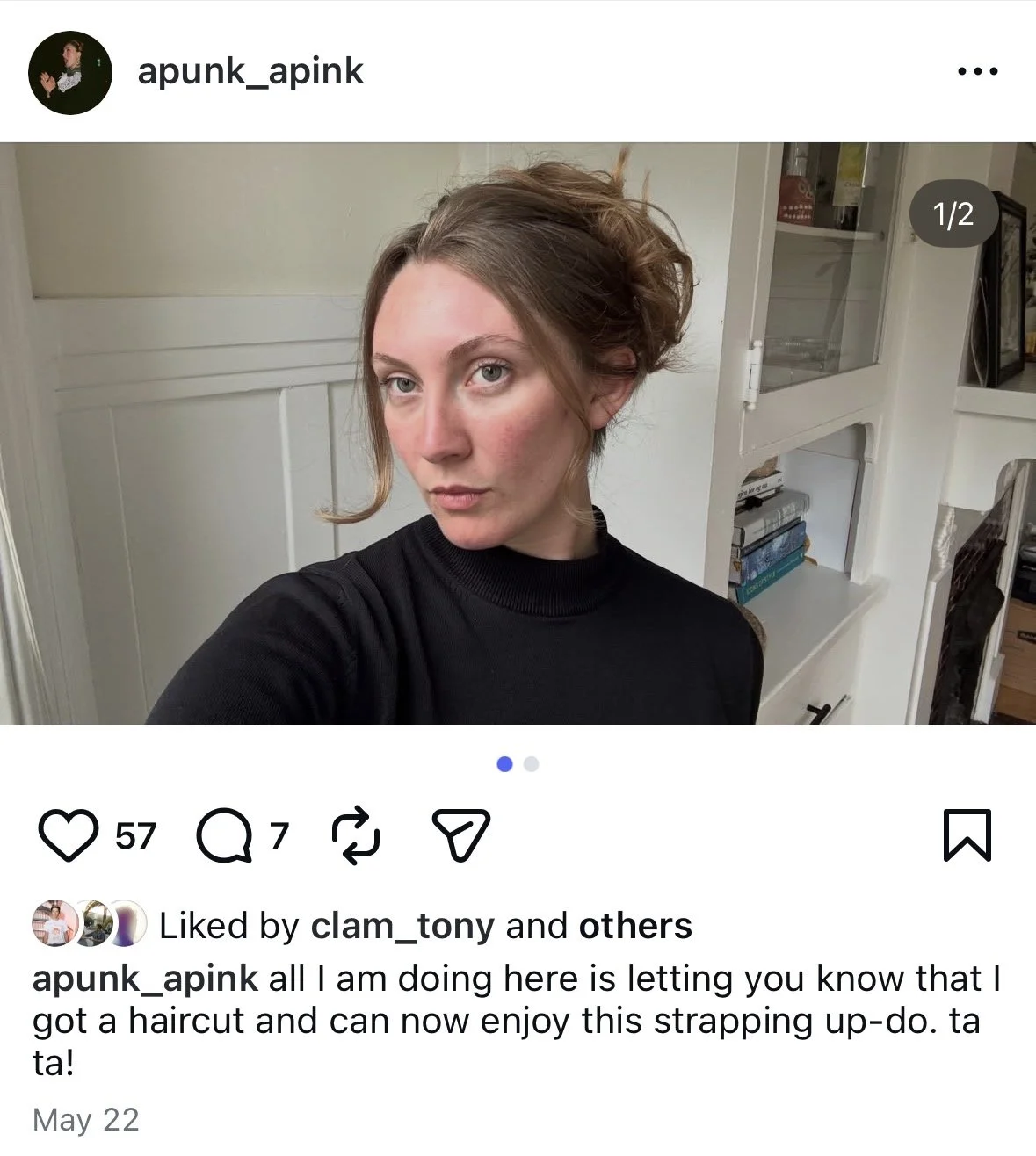
I would like to address my latest Instagram post: the images and the accompanying text.
Though Instagram is historically an image-first platform, it is most effective if we begin this analysis with the text. “Caption” is the bit of technological lingua-franca which refers to the small, plain-text fragment of language attached to an image or video on any given internet platform. The formatting of the text is not highly manipulable, and the length is often capped by character count. In calling this text a “caption” we associate it with closed-captions used in film, understood to mean text which glosses or describes the auditory element of a motion picture. In the context of Instagram, the “caption” can therefore be understood as descriptive. Of course, the actual proximity of the visual contents of the image and the subject of the text-based caption is up to the author, and common practice allows captions to range from didactic to oblique, accompanied by a range of attendant tonal implications.
In the case of my latest Instagram post, the caption reads, “all I am doing here is letting you know that I got a haircut and can now enjoy this strapping up-do. ta ta!” Digitally-literate readers will quickly register that this text does not follow typical sentence-casing, and is therefore proffered to establish an attitude of informality. Linguistically, the caption starts right in with its task of obfuscation. The phrase “all I am doing” establishes an implicit presumption of work on the part of the image, and presents an immediate undercutting or dismissal of that assumed intent. There is the assumption that a receptive audience could, without the aid of the caption, potentially read another meaning into these images. “Not that, but this,” the caption seems to say.
Next, the caption states that the author intends to let “you [the audience] know that I got a haircut….” In directly acknowledging the audience, the author publicly claims the post as a missive with intent, bound for an anticipated “you.” The true scope of this “you” depends on the author’s individual account settings; if the account is private, only a pre-selected group of individuals will ever be able to receive this message. If the account is public, any number of people might see the post. That being said, the author still has the ability to “block” certain people from seeing their content, a digital cloaking of existence in which both the blocked account and the author’s account become mutually inaccessible. (This method is not fool-proof, however, and the intrepid sleuth can find ways around the safe-guard.) While some authors have public accounts with one hundred followers, others have one million followers. Still, the expectant potential audience is the same. This “you” could be anyone, anywhere. In this case, the author’s account is public. The “you” yawns wide.
And yet, the message of the caption is distinct in its directness and intimacy. The author writes of “a haircut,” which allows them to “enjoy this strapping up-do.” “This strapping up-do” makes direct reference to the two images which comprise the post, arranged in a “carousel” in which the viewer of the post is able, with a single finger, to swipe from right to left, displaying two similar images of a woman, her hair swept up in a vaguely French-looking hairstyle, two mirrored tendrils framing her face as she makes direct eye contact with the camera. These single-frame photographic images capture a distinct, unedited moment in time in which a woman in her late-twenties or early-thirties stands in an interior in westward-facing, mid-evening light.
Let us continue by evaluating the quality of the subject’s gaze. In the first image in the carousel, the woman looks directly at the camera, chin down, lips closed or even slightly pursed, the slight pressure exerted accentuating a feline upper-lip. The right side of the woman’s face is in shadow, and the lines of her nose, cheekbone, jaw, and neck are all accentuated. The tone of the gaze is slightly confrontational. In the second image, the woman appears in the same location, but the quality of the gaze is slightly softer, the woman’s jaw lifted, her face less shadowed. Her lips are held less tensely and are more available to the viewer’s gaze. Similarly, she meets the eye of the camera more levelly, as if on even ground. The angle and position of the camera remain essentially the same, as does the overall lighting of the image. It is likely that these images were captured within seconds of each other.
In On Photography Susan Sontag writes, photographs “are experience captured, and the camera is the ideal arm of consciousness in its acquisitive mood.” This acquisitiveness is certainly at play here. While beauty in the moving world is fleeting, beauty in the still image is beauty preserved and catalogued. If the photographic impulse originates from a recognition of this beauty, a desire to fasten the moment to itself, then the desire to share the resultant image comes as a sort of trophy-ism, for which the Instagram profile is engineered as a perfect repository.
Considering the photographs in this particular post, from the directness of the gaze, the lack of another subject in the frame, the focus on the woman’s eyes, lips, and hair, we can assume that the intent of capturing these images was driven by an aesthetic impulse. And the author being reasonably satisfied with these images of themself, it can also be assumed that the intent of posting these images for public viewing is to claim in their appearance a momentary aesthetic success. These images, taken by the photographic subject, are “selfies.” Sometimes, selfies are considered “thirst traps,” if the images are enticing enough to inspire sexual or romantic interest. In a markedly more dated construction, images like these could be considered “#GPOY,” literally “gratuitous pictures of yourself.”
For those able to glean information from these images in a fraction of a second, the caption fails to offer substantial new information. The only thing not immediately evident from the photographs themselves is the disclosure of the haircut. Only with very close observation could a keen viewer discern a difference between other recent images of the woman (available on a “profile”) and this one. What, then, is the caption actually doing?
Herein lies the crux of the post: returning to the opening phrase, the author writes, “all I am doing here is letting you know […].” It is a clear meeting of the expectation that a picture of oneself posted to Instagram is performing a particular kind of function. In the case of either the “thirst trap” or the “#GPOY,” the author acknowledges a desire to post an image of themselves. While one is classed as “gratuitous,” not needed and perhaps not useful, another is classed as a “trap” to ensnare those “thirsty,” desperate, yearning, for contact; both demonstrate intent.
In obfuscating or even denying either intent with this economical little phrase (“all I am doing”), the author indeed acknowledges the audience’s expectation of this image’s work, whether that be superfluousness or ensnarement. So, one is left wondering: really, is that all you’re doing here? Susan Sontag writes, “society becomes ‘modern’ when one of its chief activities is producing and consuming images, when images […] become indispensable to […] the stability of the polity, and the pursuit of private happiness.” In the instance of this author’s post, and their concerted efforts to define the work of the image, we see the production and consumption of images as it pertains to “the pursuit of private happiness.” Though it’s difficult to assign a discrete level of happiness achieved, either for the author or for the audience, it is evident that in producing and disseminating these images (as the author), and in consuming these images (as the audience), there is a sort of symbiotic digestion of the private, the mundane.
The caption ends with the brief, “ta ta,” a salutation that again underscores a light-heartedness, an onomatopoeic tossing away of the language which precedes it. These images are neither the first nor the last in a long string of photographs of the self, and the author seems to sing, “I’ll be back soon!” No need to fret; it is a promise to see you again, easily made and kept.